
Ureaplasma Test: How It Works

A ureaplasma test is a lab test on a urine sample or a swab that looks for the DNA of ureaplasma bacteria. It shows whether ureaplasma is there. It does not show whether ureaplasma is causing your symptoms, because many people carry it without getting sick.
We test for ureaplasma in Midtown Manhattan. See the price and book ↓
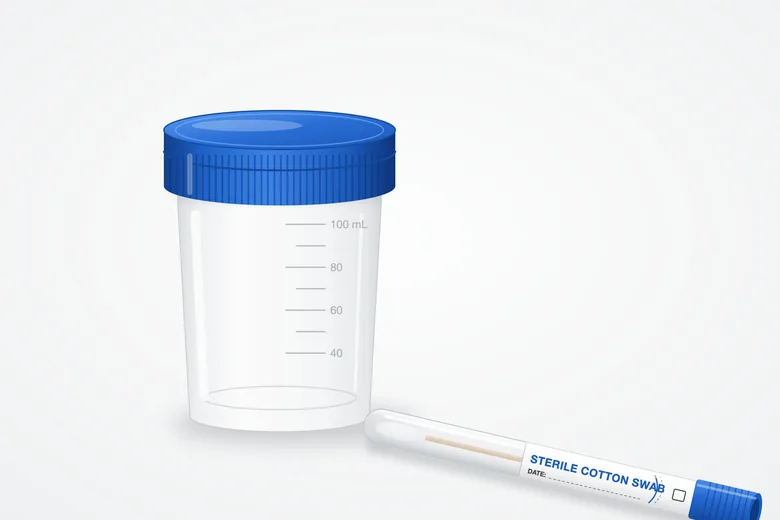
| Sample | Urine or a swab |
|---|---|
| Type of test | NAA (nucleic acid amplification), a DNA test. PCR is one kind. |
| Name on the lab report | Ureaplasma spp NAA |
| One sample reports | Ureaplasma, Mycoplasma genitalium and Mycoplasma hominis |
| Results | 4 to 7 days |
| Rapid test | Not available |
| Ureaplasma test cost without insurance | $196: $90 office visit plus $106 lab test |
| With insurance | Covered when we're in your network |
How to test for ureaplasma: urine or swab
To test for ureaplasma, you give a urine sample or a swab at a doctor's office, and a lab runs a DNA test on it to look for the bacteria. You don't need a blood draw. Results come back within a week.
-
1
See the doctor.
A doctor sees you and asks about your symptoms.
-
2
Give the sample.
You pee in a cup or give a swab.
-
3
The lab tests it.
We send the sample to an outside lab.
-
4
Get your result.
The lab sends it back to us.
For timing after a new partner, see how long after sex to get tested.
Before the sample
For a urine sample, or a swab from the penis, don't pee for at least one hour beforehand. The lab needs the first part of the urine stream, not the middle.
PCR or culture?
Labs can find ureaplasma by culture or by a DNA test. Mayo Clinic Laboratories calls culture slow, skilled work that takes several days, and it has replaced culture with PCR, a faster DNA test. The test we order is a DNA test too.
Ureaplasma test for men and for women
Men and women take the same ureaplasma test. Men give urine or a swab from the opening of the penis, and women give urine or a swab from the vagina or cervix. What differs is the condition doctors look for and the other infections they check first.
| Men | Women | |
|---|---|---|
| Condition doctors look for | Urethritis | Cervicitis |
| Linked to ureaplasma? | One species only, Ureaplasma urealyticum (2014 review) | No specific evidence (CDC) |
| Check first | Chlamydia and gonorrhea (CDC) | Bacterial vaginosis, or BV (European STI guidelines board) |
Ureaplasma in men
In men, the concern is urethritis: inflammation of the urethra, the tube you pee through. The CDC lists its symptoms as burning when you pee, itching in the urethra and discharge.
Ureaplasma has two species. A 2014 review of 7 studies found Ureaplasma urealyticum in 18.31% of men with urethritis that was not gonorrhea and in 13.74% of men without it. Ureaplasma parvum went the other way: 10.22% of men with that urethritis and 17.74% of men without.
The authors concluded that the evidence supports U. urealyticum, but not U. parvum, as a cause. Even so, the CDC notes that most men with ureaplasma have no obvious illness unless the amount of bacteria is high.
Ureaplasma in women
In women, the question is usually cervicitis, an inflammation of the cervix. It often causes no symptoms, though some women notice unusual discharge or bleeding between periods, according to the CDC.
The CDC says no specific evidence exists that either ureaplasma species causes cervicitis. It does not recommend testing for them when a doctor checks for it.
The European STI guidelines board says doctors should always test women with symptoms for BV. Our rapid BV test gives a result in 30 minutes.
Who should get tested for ureaplasma, and who doesn't need it
Guidelines do not recommend routine ureaplasma testing. The CDC's STD screening recommendations leave ureaplasma out, and the European STI guidelines board advises against routine testing of men and women, with or without symptoms. The board says there is no evidence that finding and treating ureaplasma does more good than harm.
Why don't doctors test for ureaplasma?
Doctors don't routinely test for ureaplasma because carrying it is common, and most people who carry it do not develop disease. A positive result also doesn't prove the cause: the CDC calls the data on ureaplasma and urethritis inconsistent. And the European board warns that wide testing and treatment may breed bacteria that antibiotics no longer kill.
If testing is done
If a doctor tests a man with urethritis symptoms, the European board says to rule out gonorrhea, chlamydia and Mycoplasma genitalium first.
If you still want the test, I order it. Not sure your symptoms fit? See ureaplasma symptoms.
Mycoplasma and ureaplasma test: one sample, three results
The lab we use most runs mycoplasma and ureaplasma as one test, called a profile. From one sample, the report shows three separate results: Ureaplasma species, Mycoplasma genitalium and Mycoplasma hominis. These are three different bacteria, and the guidelines treat each one differently.
| Line on the report | What the guidelines say |
|---|---|
| Ureaplasma spp NAA | Routine testing is not recommended (European board). |
| Mycoplasma genitalium NAA | It causes about 15% to 20% of urethritis in men that is not gonorrhea, and it has an FDA-cleared test (CDC, 2021). |
| Mycoplasma hominis NAA | Testing is not recommended when a doctor checks for cervicitis (CDC). |
If Mycoplasma genitalium is your only question, a test for it alone costs $35 at the lab, not $106. See Mycoplasma genitalium.
How long does a ureaplasma test take?
A ureaplasma test result takes 4 to 7 days at our office. An outside lab runs the test and reports back to us. We have no rapid version, so you can't get a same-day answer the way you can with some other STD tests.
How accurate is the test?
Mayo Clinic Laboratories calls PCR testing for ureaplasma sensitive and specific: good at finding the bacteria and at not confusing them with others. No test is perfect. A negative result does not rule ureaplasma out, for example when a sample holds too little DNA to detect.
The lab developed this test and checked how well it performs. The FDA has not cleared or approved it, and the FDA has determined that clearance is not necessary.
What does "Ureaplasma spp NAA" mean on a lab report?
"Ureaplasma spp NAA" is the line on a lab report for the ureaplasma test. "Spp" is short for species: the lab looked for any ureaplasma species and did not name which one. "NAA" stands for nucleic acid amplification, a method that copies and detects the bacteria's DNA, and the result reads positive or negative.
What the line leaves out
- Which species. The line does not say whether the lab found Ureaplasma urealyticum or Ureaplasma parvum.
- How much. The result is yes or no, with no amount.
When doctors test men with urethritis, the European board advises tests that name the species and measure the amount. This test does neither.
What does a positive ureaplasma test mean?
A positive ureaplasma test means the lab found ureaplasma DNA in your sample. It does not prove that ureaplasma is causing your symptoms, and it is not proof of a ureaplasma infection that needs treatment. Ureaplasma can be part of the normal bacteria of the genital tract.
On a report, a positive may read "Ureaplasma spp NAA: Positive."
Should I be worried if I test positive for ureaplasma?
A positive result on its own is not a reason to worry. With no symptoms, the European board does not recommend treatment. With symptoms, a doctor first rules out other causes, and our rapid chlamydia and gonorrhea test gives results in 30 minutes.
Ureaplasma parvum positive or Ureaplasma urealyticum positive
Some lab reports name the species. The 2014 review linked U. urealyticum, but not U. parvum, to urethritis in men.
If your result is positive: do you need treatment?
Not every positive result needs treatment: the European STI guidelines board says doctors should consider it only for men with a high amount of U. urealyticum. The board adds that good evidence on which treatment works best is lacking. The CDC has no treatment plan for ureaplasma by name.
I treat when you have symptoms, or when you are in a relationship and it is causing symptoms in your partner.
We follow the CDC's treatment for urethritis that is not gonorrhea: doxycycline 100 mg by mouth twice a day for 7 days. The CDC's alternatives are azithromycin 1 g in a single dose, or azithromycin 500 mg once and then 250 mg a day for 4 days. We call the prescription into your pharmacy.
Our ureaplasma treatment page covers antibiotic choices and how long clearing takes.
Should your partner be tested for ureaplasma?
The CDC gives no partner advice for ureaplasma by name. Its advice covers men with urethritis that is not gonorrhea: it says to refer their sex partners from the past 60 days for a checkup and testing. For ureaplasma itself, the European board does not recommend testing people who have no symptoms.
For how it passes between partners and how long it can go unnoticed, see whether your partner has it too.