
Does Insurance Cover STD Testing?

Does insurance cover STD testing? Yes — most health plans do. Federal law makes most plans pay in full for certain screening tests, such as HIV and hepatitis C, when you use an office in your plan's network.
Other STD tests are often covered as regular lab work, but you may owe a copay or part of your deductible.
At STD Center NY in Midtown Manhattan, we accept four insurance plans. See the plans and what you pay ↓
Quick answers
| Question | Short answer |
|---|---|
| Is STD testing covered? | Usually, yes |
| Is it free? | Some screening tests are, at an office in your plan's network |
| Plans we accept | Aetna, Anthem Blue Cross Blue Shield (formerly Empire), Oxford, UnitedHealthcare |
| If we don't take your plan | $90 office visit. Your lab tests and prescriptions still go through your insurance. |
| Rapid tests (results in 30 minutes) | Not billed to insurance. $70–$180 per test, with no office visit fee. |
| Does it show up on insurance? | Yes. Many plans send a statement to the person whose name is on the plan. |
Does Health Insurance Cover STD Testing?
Usually, yes. The Affordable Care Act, a federal law, requires most health plans to pay in full for a set list of screening tests. In most cases you owe no copay, even if you haven't met your deductible, when the office and lab are in your plan's network.
So is STD testing covered by insurance when the test isn't on that list? Often, but you may have to pay part of the cost. Plans sold on the government Marketplace must include lab services, and your plan's usual cost-sharing applies:
- Copay: a fixed amount you pay for a service, such as $20.
- Deductible: what you pay for covered care before your plan starts to pay.
- Coinsurance: a share of the cost, such as 20%, that you pay after your deductible.
"Covered" and "free" are not the same thing. HealthCare.gov, the federal insurance site, warns that a $0 cost isn't guaranteed in every case.
Insurance We Accept at STD Center NY
We accept four insurance plans: Aetna, Anthem Blue Cross Blue Shield (formerly Empire), Oxford and UnitedHealthcare. If we take your plan, your office visit and lab tests go through it. If we don't, you pay a $90 office visit, and your lab tests and prescriptions still go through your insurance.
What you pay
| Office visit | Lab tests | Prescriptions | |
|---|---|---|---|
| We take your plan | Billed to your plan | Billed to your plan | Filled with your plan |
| You have insurance we don't take | $90, paid to us | Billed to your plan by the lab | Filled with your plan |
| No insurance, or you'd rather not use it | $90 for lab tests. No visit fee for rapid tests. | The lab bills you. Rapid tests are $70–$180 each, paid to us. | You pay the pharmacy |
We don't accept Medicare or Medicaid plans, or Blue Cross Blue Shield plans from other states.
Your plan sets any copay or deductible. Paying on your own? See our self-pay prices.
I see every patient myself, whichever way you pay.
Who bills what
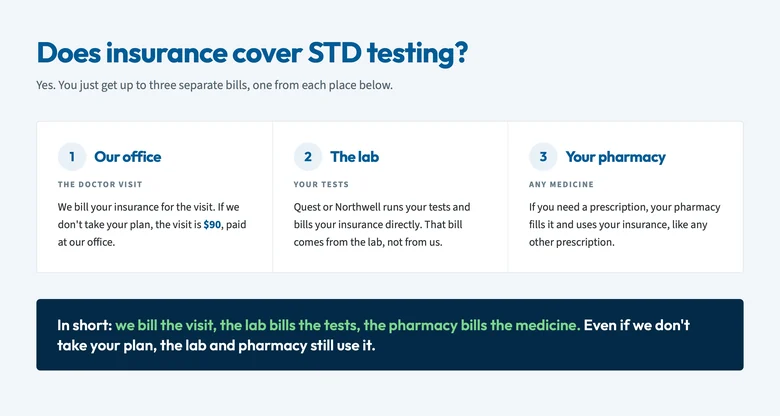
One visit can lead to three separate bills:
- Our office bills for the visit.
- The lab bills for your tests. We send your sample to Quest or Northwell, whichever takes your insurance, and the lab bills your plan itself. That is why your tests go through your insurance even when our office isn't in your plan's network.
- Your pharmacy bills for any medicine. If a result is positive, we call the prescription in to the pharmacy you choose.
Blood test results take 1 to 2 days. Urine and swab results take 3 to 5 days.
We don't give receipts to send to your insurer for repayment. If you have insurance, use it at the visit.
Rapid tests and insurance
We don't bill rapid tests to insurance. Rapid tests give results in 30 minutes and cost $70 to $180 per test, with no office visit fee. Not every infection has a rapid test.
What to bring
- Your insurance card
- A government-issued ID for lab tests
- A card for payment. We take HSA and FSA cards. Credit cards add a 3.5% fee; debit, HSA and FSA cards don't.
Not sure we take your plan? Call 212.696.5900 before you come.
Are STD Tests Free With Insurance?
Some are. Most plans must pay in full for certain screening tests — tests done when you have no symptoms. Which ones depends on your age, sex and risk: HIV and hepatitis C screening are free for most adults, while chlamydia and gonorrhea screening are listed for some women but not for most men.
Screening tests most plans must cover at no cost
| Test | Who gets it at no cost |
|---|---|
| HIV | Everyone aged 15 to 65, and people of other ages at increased risk |
| Hepatitis C | Adults aged 18 to 79 |
| Syphilis | Adults at increased risk |
| Hepatitis B | People at high risk |
| Chlamydia | Sexually active women 24 and younger, and women 25 and older at increased risk |
| Gonorrhea | Sexually active women 24 and younger, and women 25 and older at increased risk |
Sources: HealthCare.gov and the U.S. Preventive Services Task Force, 2019–2022. The rule applies at in-network offices, and to plans that are not "grandfathered" (explained below). It also covers some screening during pregnancy and, under pediatric guidelines, for adolescents.
Does insurance cover STD testing without symptoms?
Yes. Testing without symptoms is called screening, and screening is what the no-cost rule covers — for the tests and groups in the table. For syphilis, the Task Force says the risk is higher in men who have sex with men and in people with HIV.
Chlamydia and gonorrhea tests for men
For most men, these are not on the no-cost list. The Task Force says there isn't enough evidence to weigh the benefits and harms of screening men. Your plan can still pay for the test, but it may apply your copay or deductible.
Tests that aren't on the list
Herpes, trichomoniasis, mycoplasma and ureaplasma tests are not on the no-cost list. For herpes, the Task Force recommends against routine blood tests in people without symptoms. See how to test for herpes for when a test makes sense.
Why Insurance Doesn't Always Pay for STD Testing in Full
If you're asking "why does my insurance not cover STD testing?", the reason is often how the test was billed. Plans only have to pay in full for screening on the federal list. A test ordered because of symptoms is diagnostic care, and your copay, deductible or coinsurance applies.
Common reasons for a bill:
- You had symptoms. A test to find the cause of a symptom is diagnostic, not screening.
- The test isn't on the list for you. A chlamydia test for a man, or a ureaplasma test, falls outside the no-cost rule.
- The office or lab was out of network. The no-cost rule applies to in-network care.
- Your plan is grandfathered. A grandfathered plan — one that dates from March 23, 2010 or earlier — doesn't have to offer free preventive care. Your plan's papers say whether it is grandfathered.
- You haven't met your deductible. For tests outside the list, you may pay the full cost until you reach it.
Whether a test counts as screening depends on your situation. UnitedHealthcare, for example, says STI testing may or may not count as preventive care.
Before your visit, call the number on your insurance card and ask:
- Is STD screening covered at no cost?
- Is this office in my network?
- What will I owe for lab tests?
Does My Insurance Cover STD Testing? Aetna, Blue Cross Blue Shield, UnitedHealthcare
In most cases, yes, at least in part. The federal no-cost screening rule does not depend on the insurer: it applies to most plans, and the main exception is a grandfathered plan. What differs from plan to plan is what you owe for tests outside that list, and which offices and labs are in network.
Does Aetna cover STD testing?
Usually, yes. The federal rule covers most Aetna plans, as it does other insurers' plans, so the listed screening tests usually cost nothing at an in-network office. We accept Aetna.
Does Blue Cross Blue Shield cover STD testing?
Usually, yes. Most Blue Cross Blue Shield plans must follow the same rule. We accept Anthem Blue Cross Blue Shield, called Empire BlueCross BlueShield until 2024, but not Blue Cross Blue Shield plans from other states.
Does UnitedHealthcare cover STD testing?
Yes. UnitedHealthcare's own policy, in effect October 1, 2026, lists screening for chlamydia, gonorrhea, HIV, syphilis and hepatitis B and C as preventive care with no cost-sharing at in-network offices, on plans that are not grandfathered. We accept UnitedHealthcare and Oxford.
Does STD Testing Show Up on Insurance?
Yes. When a test is billed to insurance, many plans send a statement called an explanation of benefits (EOB) to the policyholder — the person whose name is on the plan. It shows the date, the provider and a description of each service, which can include the tests that were done.
People often ask whether STD testing shows up on an insurance bill. The statement is not a bill, but it does list the visit.
Will my parents know if I get an STD test on their insurance?
They can. You can usually stay on a parent's plan until you turn 26, and the statement can go to the parent as the policyholder. We see patients 18 and older.
How to keep a test private
- Ask your insurer to send your statements somewhere else. Federal privacy rules and New York State rules say an insurer must honor a reasonable request to use a different address, phone or email when you state that disclosure could put you in danger. New York's Department of Financial Services has a sample request form. For other reasons, ask your insurer what it allows.
- Pay on your own. A visit you pay for in full is not billed to insurance, so no statement is sent. Under federal privacy rules, you can also ask a medical office not to share a service with your plan when you pay for it in full. Rapid STD testing at our office is always paid at the visit.
- Know where the lab bill goes. If you pay for lab tests on your own, Northwell mails the bill to your home.
How Often Does Insurance Cover STD Testing?
Federal rules don't set a number of tests per year. Where a screening guideline gives no schedule, they let your plan set reasonable limits, so ask your plan how often it pays. The CDC advises chlamydia, gonorrhea and syphilis tests at least once a year for sexually active men who have sex with men.
Guidelines say how often to test, not what your plan must pay for. The Task Force says it has not found a best interval for repeat HIV testing, and that repeat testing is reasonable for people at increased risk. For syphilis, it says men who have sex with men and people with HIV may benefit from testing at least once a year, or every 3 to 6 months if they stay at high risk.
Does insurance cover STD testing more than once a year? It can, when your risk or symptoms give your doctor a reason to test again.
At our office there is no limit on how often you can get tested. If you're testing after a specific contact, timing matters: see how long after sex to get tested.