How to Test for Herpes: Swab vs. Blood Test

How to test for herpes depends mainly on one thing: whether you have a sore right now. If you do, a doctor swabs the sore and a lab checks the sample for the virus. If you don't, the test is a blood test that looks for herpes antibodies, proteins your body makes to fight the virus.
A doctor's look alone isn't enough. The Centers for Disease Control and Prevention (CDC) advises confirming a suspected herpes sore with a lab test. Not sure the bump is herpes at all? See what else can look like herpes →
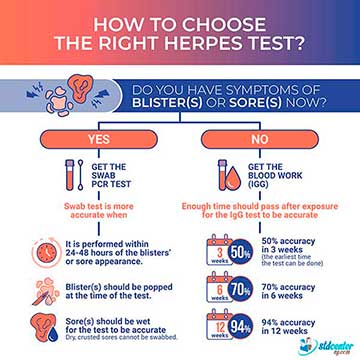
| Swab test | Blood test | |
|---|---|---|
| When it's used | You have a sore now | You have no sore |
| What it looks for | The virus itself, in a sample from the sore | Antibodies to the virus in your blood |
| Tells HSV-1 from HSV-2 | Yes | Yes, if it's a type-specific test |
| Timing | Best on a fresh sore, before it crusts | Can miss a new infection; retest at 12 weeks (CDC) |
| Results at our office | 3–5 days | Next day to 2 days |
| Main limit | A negative result doesn't rule herpes out | Low positive HSV-2 results are often false |
Can you test for herpes without an outbreak?
You can, with a type-specific IgG blood test, which tells HSV-1 from HSV-2, the two types of herpes simplex virus. But the CDC and the U.S. Preventive Services Task Force both advise against routine screening, partly because the most common test often gives false-positive results: positive when you don't have herpes.
For most people without symptoms, the question isn't how to test for herpes but whether a test is worth it. The CDC lists three situations when a blood test makes sense:
- You have repeat or unusual genital symptoms, but a swab came back negative.
- A doctor diagnosed genital herpes from an exam, without a lab test to confirm it.
- Your partner has genital herpes.
Why doctors don't test for herpes routinely. On the most common HSV-2 blood test, low positive results, an index value between 1.1 and 3.0 (the number the lab reports), are often false. The CDC advises confirming them with a second, different test, such as the Western blot done at the University of Washington, before reading the result. Our office doesn't arrange that test. How to read your herpes blood test index value →
What a herpes blood test can't tell you
- A positive HSV-1 result can't tell whether the infection is in the mouth or the genitals. Many people pick up HSV-1 in childhood.
- Antibodies last for life, so a positive result can reflect an infection from years ago.
- The CDC doesn't recommend IgM tests, an early-antibody test: they don't tell HSV-1 from HSV-2 and can turn positive during a repeat outbreak.
- Doctors don't swab skin that has no sore, because it misses too much.
The blood test we order is the type-specific IgG test for HSV-1 and HSV-2.
How soon after exposure can you test for herpes?
It depends on the test. A doctor can swab a sore as soon as it appears. A blood test needs time: antibodies form over the first weeks after infection, so an early test can be falsely negative. The CDC advises repeating the blood test 12 weeks after a suspected HSV-2 exposure.
How long do herpes test results take?
At our office, swab results take 3–5 days and blood results take next day to 2 days. Both samples go to an outside lab, which is why results aren't same-day.
If you're testing after an exposure, other STDs have their own testing windows. When to test for each STD after exposure →
How do they test for herpes in men and women?
The same way in males and females. If there's a sore, the doctor swabs it wherever it is: on the genitals, around the anus, or in the mouth. If there's no sore, men and women get the same blood test. For women: a Pap test does not check for herpes, so a normal Pap result doesn't rule out herpes.
HSV-1, the type often behind oral herpes, now causes a growing share of genital herpes, especially in young women and in men who have sex with men, according to the CDC. The difference between HSV-1 and HSV-2 →
How to test for herpes with a swab: PCR vs. culture
A herpes swab test collects a sample from a sore. The lab then tests the sample one of two ways: PCR, which finds the virus's genetic material, or culture, which tries to grow the virus. PCR is the more sensitive of the two, meaning it misses fewer infections, and both can tell HSV-1 from HSV-2.
PCR. A herpes PCR test is the most sensitive way to test a sore, according to the CDC. Tests cleared by the FDA catch 90.9% to 100% of infections and rarely give false-positive results.
Culture. Culture misses more infections, especially in repeat outbreaks, and it misses more as the sore starts to heal. In one 2002 clinic study of 236 patients, PCR found 24% more herpes infections than culture alone.
What it feels like. The swab takes a few seconds and may sting briefly.
Timing matters. The fresher the sore, the better the test works. What a herpes sore looks like at each stage →
Can you test negative for herpes and still have it?
Yes. A swab from a sore that's already healing can miss the virus, and because the virus shows up on the skin only on and off, a negative swab doesn't rule herpes out. A blood test taken too soon after infection can also come back negative. A positive PCR swab, by contrast, is reliable.
Blood tests can miss infections too: according to the CDC, they catch 80% to 98% of HSV-2 infections.
Because herpes swab test accuracy drops as a sore heals, it helps to be seen quickly. At STD Center NY, a doctor sees every patient.