
Brown Discharge: What It Means

Brown discharge is usually a small amount of blood mixed with normal vaginal discharge. Often it comes from the start or end of a period, from ovulation or from birth control, and it is harmless.
Sometimes it is a sign of an STD, such as chlamydia or gonorrhea. When it shows up and what comes with it tell you more than the shade of brown.
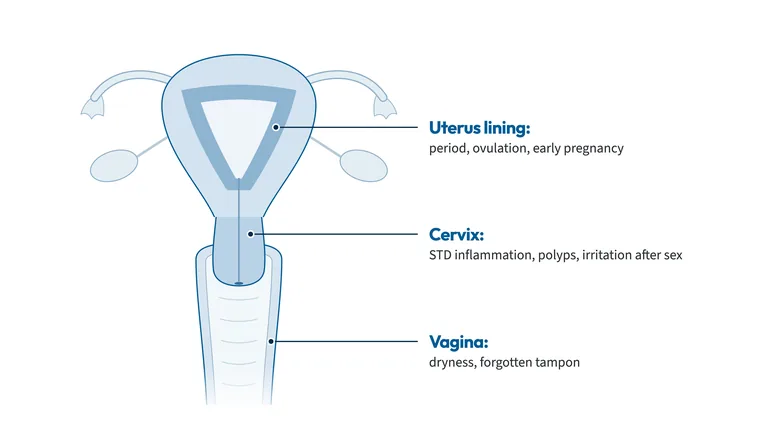
Why Is My Discharge Brown? What the Timing Tells You
Discharge turns brown when a little blood mixes into it. That blood usually comes from the uterus (a period or early pregnancy) or from the cervix (an STD, a polyp, or irritation after sex). Timing is the best clue to which one, and this table sums up what each pattern usually means.
| When you notice it | Most likely cause | What to do |
|---|---|---|
| Right before or right after your period | Light bleeding at the start or end of the period | Nothing, if your cycle is otherwise normal |
| Midway between periods | Slight bleeding with ovulation | Get it checked once if it is new for you |
| While on the pill, patch, ring, shot, implant or an IUD | Spotting from birth control | Talk with the doctor who prescribed it |
| After sex | Irritation or dryness, a polyp, or an STD such as chlamydia | Get checked, including an STD test |
| With odor, itching, burning or pelvic pain | An STD, PID, or a forgotten tampon | See a doctor soon |
| When your period is late | Implantation spotting, or a pregnancy problem | Take a pregnancy test and call an ob-gyn |
| After menopause | Needs a doctor to find the cause | See a gynecologist |
Is Brown Discharge Normal?
Often, yes. Brown discharge at the start or end of a period is normal: on lighter days, period blood may be pink or brown. Slight bleeding can also come with ovulation, and hormonal birth control or an IUD can cause spotting.
Still, the NHS advises getting brown vaginal discharge between periods checked once, even when the cause turns out to be harmless.
Light brown vs dark brown discharge
Both shades usually mean a little blood is mixed in, and neither one tells you the cause. Healthdirect, Australia's government health service, puts it plainly: color alone cannot diagnose the cause of abnormal discharge.
Dark brown discharge at the end of a period and light brown discharge after sex can come from very different things. Timing and other symptoms tell you more.
Brown stringy discharge
Around ovulation, discharge gets clearer, wetter and more noticeable. If the light ovulation spotting mentioned above mixes in, it can look like stringy or mucus-like brown discharge in the middle of your cycle. If there is any chance you are pregnant, read the pregnancy section below.
Spotting in your 40s and around menopause
During perimenopause (the years before periods stop, around age 50), the time between periods can change, and skipped, lighter or heavier periods are common. The American College of Obstetricians and Gynecologists (ACOG) still advises talking with your ob-gyn about any abnormal bleeding.
Once periods have stopped for good, brown discharge is never "just a period." See the section on brown discharge after menopause below.
What STD Causes Brown Discharge?
Chlamydia and gonorrhea are the STDs most often behind brown discharge. The CDC names them as the most common causes of cervicitis, an inflamed cervix that bleeds easily, especially after sex. Trichomoniasis, Mycoplasma genitalium and a first herpes infection can inflame the cervix too.
Many women with these infections notice nothing at all.
Chlamydia and gonorrhea
Chlamydia often has no symptoms, and most women with gonorrhea have none either. When they do cause symptoms, the table in the next section shows what to look for.
Both infections are curable with the right treatment. Left untreated, they can cause pelvic inflammatory disease (PID), which can scar the fallopian tubes and lead to an ectopic pregnancy or trouble getting pregnant. For how the two infections compare, see chlamydia vs gonorrhea.
Trichomoniasis
About 70% of people with trichomoniasis (trich) have no symptoms. When it does cause them, the discharge often smells fishy, and trich is also linked to an inflamed cervix.
The CDC estimated more than 2 million trich infections in the U.S. in 2018, and it is the most common curable STI.
Mycoplasma genitalium and herpes
Mycoplasma genitalium (Mgen) and a first genital herpes infection are less common causes of an inflamed cervix. Herpes also tends to cause blisters or sores.
Pelvic inflammatory disease (PID)
PID is an infection of the reproductive organs, often caused by untreated chlamydia or gonorrhea. Signs include pain in the lower belly, fever, unusual discharge with a bad odor, pain or bleeding during sex, burning when peeing, and bleeding between periods.
Symptoms can be mild or missing, so see a doctor promptly if you have pelvic pain along with brown discharge.
Brown discharge isn't always an STD
Even when the cervix is inflamed, testing often finds no germ, especially in women over 30, the CDC notes.
What Does STI Discharge Look Like?
There is no single "STI discharge." Each infection tends to look a little different, many cause no discharge at all, and a non-STD condition can look the same. Use this table as a rough guide only, because only testing can tell them apart.
| Infection | Typical discharge | Bleeding or brown spotting | Other signs |
|---|---|---|---|
| Chlamydia | Abnormal discharge, or none at all | Can cause bleeding between periods or after sex | Burning when peeing |
| Gonorrhea | More discharge than usual, or none at all | Bleeding between periods | Burning when peeing |
| Trichomoniasis | Thin or heavier; clear, white, yellowish or greenish; fishy smell | Linked to an inflamed cervix | Itching, burning, discomfort when peeing |
| Mycoplasma genitalium | — | Linked to an inflamed cervix | — |
| Bacterial vaginosis (BV) | Thin, white or gray; strong fishy smell, especially after sex | Not listed as a symptom | — |
| Yeast infection | Thick and white, like cottage cheese | Not a usual symptom | Itching, soreness, pain during sex |
BV is the most common vaginal condition in women ages 15 to 44, and having it raises the chance of getting other STDs, including chlamydia and gonorrhea. For how Mgen shows up in women, see Mycoplasma genitalium symptoms.
Brown Discharge After Sex
Brown discharge after sex is usually a little bleeding from the cervix or vagina. The NHS lists the usual causes: a sensitive surface on the cervix (cervical ectropion), small growths called polyps, vaginal dryness, and STIs such as chlamydia. It is not usually serious, but the NHS advises getting it checked.
If the brown discharge started after a new partner, an STD test makes sense. See how long after sex to get tested.
During pregnancy, the cervix bleeds more easily and spotting after sex is not unusual, but tell your ob-gyn about it.
Brown Discharge With Odor, Itching or Burning
A bad smell, itching or burning makes your period a less likely cause and an infection or a forgotten tampon more likely. The usual causes are trichomoniasis (fishy smell, itching), BV (fishy smell), PID (bad-smelling discharge with pelvic pain or fever) and a tampon or other object left inside.
A forgotten tampon
A tampon or other object left in the vagina can cause yellow, green, pink, gray or brown discharge with a bad smell. Remove it carefully with clean hands, and see a doctor if you can't.
Fever, a rash or dizziness with a retained tampon needs emergency care because of the rare risk of toxic shock syndrome, a serious illness.
For other reasons discharge can smell, see causes of vaginal odor.
Does Brown Discharge Mean Pregnancy?
It can. Light spotting may happen 1 to 2 weeks after fertilization, when the fertilized egg implants in the lining of the uterus, and ACOG reports some bleeding in the first 3 months in 15 to 25 of every 100 pregnancies. If your period is late, take a pregnancy test and contact an ob-gyn (a women's health doctor) about any bleeding.
When spotting in pregnancy is an emergency
Bleeding can also be a sign of early pregnancy loss (miscarriage), which happens in about 10 of every 100 known pregnancies. It can also signal an ectopic pregnancy, one growing outside the uterus, usually in a fallopian tube.
Early signs of ectopic pregnancy include abnormal bleeding, low back pain, mild belly or pelvic pain, and mild cramping on one side. Go to an emergency room for sudden, severe belly or pelvic pain, shoulder pain, weakness, dizziness or fainting.
Other Causes, and Brown Discharge After Menopause
Not every cause is an infection or a period. ACOG lists polyps and fibroids (noncancerous growths), polycystic ovary syndrome (PCOS), endometriosis and, less often, cancer among the causes of abnormal bleeding. Brown discharge after menopause is never normal, and a doctor should always check it.
Abnormal bleeding can be an early sign of endometrial (uterine) cancer. Most cases occur in women in their mid-60s who are past menopause, and it is usually found at an early stage, when treatment works best.
Cervical cancer often causes no symptoms early on. When advanced, it can cause bleeding or discharge that isn't normal for you, including bleeding after sex.
When to See a Doctor About Brown Discharge
See a doctor if brown discharge is new for you, keeps coming back, or comes with other symptoms. Get help right away for pain during a possible pregnancy, sudden severe belly pain, fever with pelvic pain, or very heavy bleeding. These two lists show how soon to go.
Make an appointment if:
- You bleed or spot between periods or after sex
- Your discharge changes color, smell or texture, or you have more than usual
- You feel itchy or sore, or it hurts to pee
- You may have been exposed to an STD
- You have any bleeding after menopause
Get help right away if:
- You could be pregnant and have bleeding with belly or pelvic pain
- You have sudden, severe belly or pelvic pain, shoulder pain, or feel weak, dizzy or faint (go to an emergency room)
- You have abnormal discharge with a fever or pelvic pain
- You soak through a pad or tampon every hour for more than 2 hours and have chest pain, shortness of breath or dizziness
- You have a tampon or object stuck inside plus a fever, rash or dizziness
Do I Need an STD Test for Brown Discharge?
If you are sexually active and the brown discharge isn't simply the start or end of your period, an STD test is a sensible step, especially after a new partner or with odor or pain. Chlamydia and gonorrhea often cause no symptoms, so a test is the only way to know.
The CDC recommends a chlamydia test every year for sexually active women under 25. The test is a vaginal swab you can take yourself, and self-collected swabs are as accurate as swabs a doctor or nurse takes. A urine sample also works.
A standard STD panel does not include herpes, so ask for a herpes test if you have sores.
At STD Center NY, a doctor sees every patient. For women, one rapid chlamydia, gonorrhea and trichomoniasis test gives results in 30 minutes or less for $180, self-pay. We also run lab tests billed to your insurance, with swab results in 3 to 5 days.
If you want an STD test even when your brown discharge is probably your period, I order it.