


 X
X

 March 25, 2023


The early signs and symptoms of HIV/AIDS
This article will summarize the most common symptoms of newly acquired HIV and their frequency, severity and timing.
Different terms, including “acute,”“recent,”“primary,” and “early,”have been used in the literature to refer to an initial infection with HIV virus.In this article, we will use mostly the term “early HIV infection” to refer to recently acquired HIV.
This article was written by Dr.Slava Fuzayloff,an expert STD doctor from the STD Center New York, thelargest private STD center in Manhattan.
Let’s start with short overview of HIV infection before diving into our main topic!
HIV/AIDS infection overview
What is it?
✓ HIV (human immunodeficiency virus) is a virus that attacksthe body’s immune system.
✓ AIDS (acquired immunodeficiency syndrome) is thelast stage of untreated HIV.
✓ There is no cure for HIV at this point, but there is effective medical care that can keep HIV under control and allowsomeone with HIVto live a long and healthy life and keep their partners protected.
Who is at risk of getting HIV?
HIV is mainly transmitted through anal or vaginal sex without protection or preventative medication (PreP,which is preexposure prophylaxis).
Certain categories of people are at higher risk of getting HIV:
✓ Teens and young adults
✓ Drug users whoshare needles, syringes, and other drug injection equipment
✓ People with multiple sexual partners
✓ People practicing unprotected sex
✓ People with other sexually transmitted infections, such as chlamydia, gonorrhea, syphilis, herpes, or even BV—the presence of these infectionsincreases the chance of getting HIV
What is the chance of getting HIV through different types of sexual contact?
Here we explain the chances of various categories of peoplegetting HIV from a sexual encounter with an HIV-positive person:
✓ Receiving oral sex is considered to pose very low risk of HIV acquisition. Sexual activity that does not involve contact with bodily fluids (semen, vaginal fluids, blood) carries no risk of HIV transmission.
✓ For receptive anal sex (receiving penis to anus, or being a “bottom”), the average chance of getting HIV from a one-time contact is 1.4%, or 1 transmission in 71 exposures.
This is true for both genders, regardless ofwhether a female or male is the bottom.
✓ For receptive vaginal sex (receiving penis into vagina), the average chance of getting HIV is 0.08%, or 1 transmission in 1,250 exposures.
✓ For insertive vaginal sex (putting penis into vagina), the average chance of getting HIV is 0.04%, or 1 transmission in 2,500 exposures.
| Type of sex | Chance of getting HIV |
| Receptive anal (when you are a “bottom”) | 0.4%–3.38% |
| Insertive anal (when you are a “top”) | 0.06%–0.62% |
| Receptive vaginal (for females) | 0.018%–0.150% |
| Insertive vaginal (for heterosexual males) | 0.03%–0.09% |
Early HIV symptoms and signs
Most people don’t get symptoms of HIV right away. It may take 2–6 weeks for symptoms to appear, because this is when your body’s immune system starts fighting the virus vigorously. This stage is known as acute retroviral syndrome.
Most early HIV symptoms are nonspecific and commonlyalso caused by other viral infections, such as flu and mononucleosis.
These are the most common symptoms of early HIV:
✓ Fever
✓ Fatigue, joint, and muscle pain
✓ Sore throat
✓ Mouth sores
✓ Body rash
✓ Lymph node enlargement
✓ Headache
✓ Diarrhea
It is important to keep in mind that about 10% to 60% of people with newly acquired HIV do not get symptoms at all.
Let’s discuss the most common early HIV symptoms and signs in more detail.
Fever
Fever is one of the most common signs of acute HIV, and 75% of symptomatic people get it.
The typical fever range is 100° to 104° F,and the mean temperature is102°.
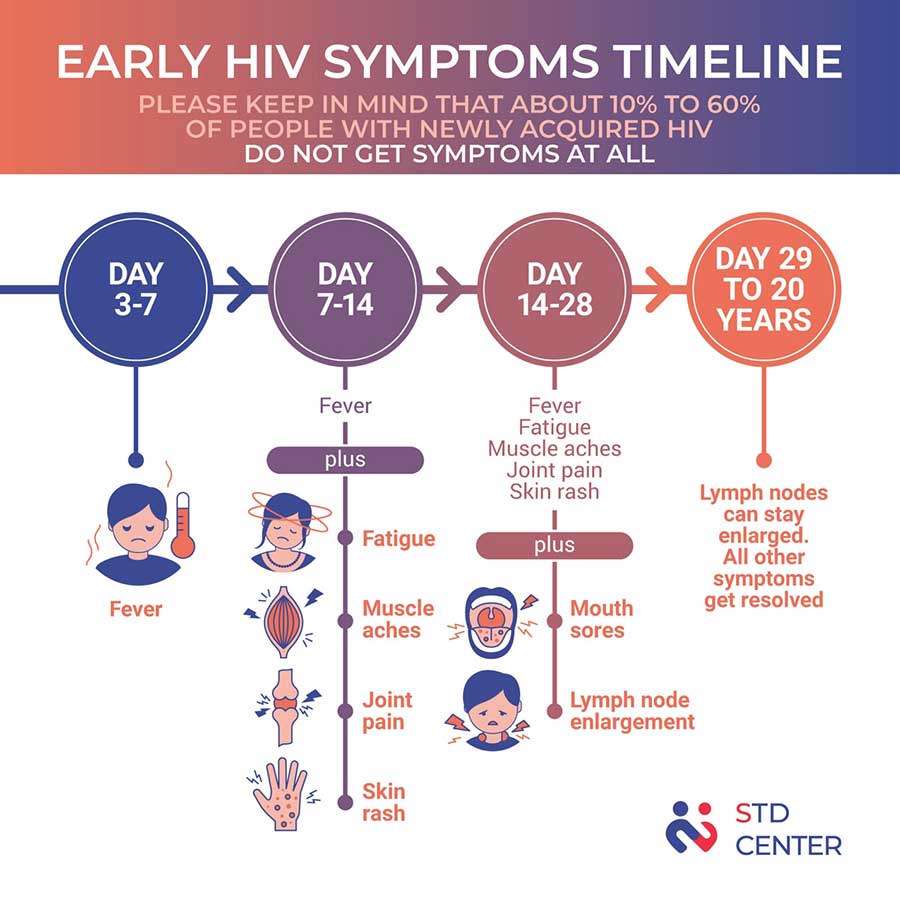
Fever can begin as early as 3 days after acquiring HIV, but most people get it in 7 to 14 days. Fever can last from one to several weeks.
Fatigueand muscle aches
Fatigue and muscle aches are other common symptoms of early HIV—68% of symptomatic people get fatigue and 49% get muscle aches.
Both fatigue and muscle aches usually occur about 7 days after contracting HIV. They are usually generalized and similar towhat you’d get with the flu.
They usually last from 3 to 7 days, and these symptoms completely resolve.
Lymph node enlargement in the neck
Lymph nodes usually become enlarged a bitlaterin the disease process: the second week of the illness. This coincides with the emergence of a specific immune response to HIV—that is, when the body reacts to the HIV virus.
Of all people with early HIV, 39% develop swollen lymph nodes.
The areas in which lymph nodes most commonly becomeenlargedare the cervical area (neck), axillary area (armpits), and occipital area (behind the head). Lymph node enlargement is usually painless. The lymph nodes are typically moderately enlarged.
Lymph node enlargement might persist for a month or longer.
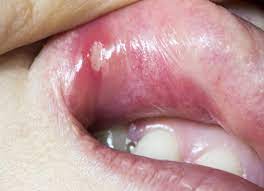
Mouth sores
Painful mouth ulceration is one of the most distinct signs of acute HIV.These sores may develop due to a weak immune system, or they can be a sign of other STDs that can coincide with HIV infection, such as herpes, syphilis, or chancroid.
Among people with any early HIV symptoms, 40% develop mouth ulcerations.
The sores are usually very shallow with a yellow base and red border.
They usually appear 7 days after getting the virus,but their arrival can be delayed for 2 or 3weeks.
Similar sores can affect the esophagus and cause painful swallowing.
Skin rash
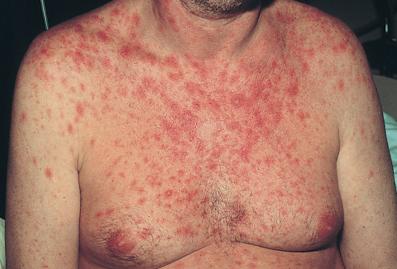
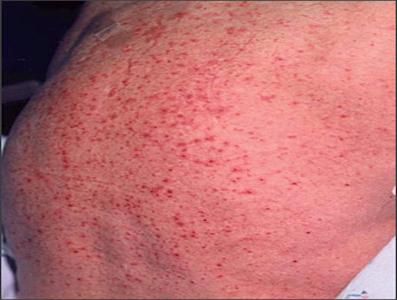
Generalized rash is a very common sign of early HIV. Rash usually follows fever and occurs 48 to 72 hours after fever onset. But rash can appear on its own as early as 3 days after HIV contraction.
Forty-eight percent of people who have early HIV symptoms get skin rash.
The rash is described as 5 to 10 mm well-defined oval or round bumps. The color of the rash can range from pink to deep red.
Skin blisters and sores are not common.
The rash is usually mildly itchy or not itchy at all.
Early HIV rash might persist for 5 to 8 days.
Taking a biopsy of the rash does not assist with establishing a diagnosis of HIV.
U.S. National Library of Medicine / National Institutes of Health
Headache
Forty-five percent of people with early HIV symptoms get headache.
The headachestarts 7 to 14 days after virus contraction.
It is usually described as pain behind the eyes (this is called retroorbital pain) that gets worse with eye movement.
Other more serious neurologic complicationsare possible, but they’re rare:
✓ Aseptic meningitis (inflammation of the lining of the brain)
✓ Meningoencephalitis (inflammation of both the lining of the brain and the brain itself)
Diarrhea
Twenty-seven percent of symptomatic people with early HIV get diarrhea.
Diarrhea usually happens between 7 and 14 days after virus contraction, and it can last for a week or two.
The diarrhea usually described as a very loose, non-bloody stool, and it is accompanied by nausea, vomiting, loss of appetite, and weight loss (the average weight loss is 10 pounds).
More serious gastrointestinal (GI) symptoms are rare. They include pancreatitis and hepatitis.
The table below shows the chances of getting various symptoms with early HIV, regardless of gender.
| Overall | |
| Fever | 76% |
| Fatigue | 69% |
| Muscle aches | 49% |
| Skin rash | 48% |
| Headache | 45% |
| Sore throat | 40% |
| Enlarged neck lymph nodes | 39% |
| Joint pain | 30% |
| Night sweats | 28% |
| Diarrhea | 27% |
This infographic shows early HIV symptoms and signs timeline.
What should I do if I believe I have HIV symptoms?
If you suspect you have an HIV infection, the following steps are necessary and responsible things to do:
Get tested for HIV
Get the proper testing for HIV. The right type of HIV test should be done to avoid false negative results.
Testing can be done in various ways:at an STD clinic or primary care physician’s office, at a lab, or via an online service.
Do not have sexual contact with your partner
Stay away from any type of sexual activity until HIV is ruled out.
Continue with PreP
Do not stop PreP,if you’re already on it, until a positive HIV diagnosis is established. PreP should be discontinued in HIV-positive patients.
Testing for “early” or “acute” HIV infection
Since HIV is associated with a wide range of symptoms, both patients and doctors should have a low threshold for suspicion.
HIV should be considered with nonspecific signs and symptoms such as fever, chills, fatigue, and muscle aches; mononucleosis-like symptoms (sore throat, fever, and chills) with both positive and negative mono tests; and with aseptic meningitis (inflammation of the lining of the brain).
More specific clinical features such as rash, mouth ulcer, and lymph node enlargement, should heighten the level of suspicion for HIV infection.
When there is a possibility of early or acute HIV based on symptoms, testing is advised.
The next question is, what is the best test that can be done to rule out HIV infection without getting a false-negative test.
HIV-specific test for early HIV infection
With early HIV infection, the following test or test combinations are advised:
✓ HIV viral load (RT-PCR–based viral load)
✓ HIV Ag/Ab
These are the most common scenarios for those combo tests:
✓ A negative HIV Ag/Ab test and positive HIV viral load test suggest early HIV infection.
✓ A negative HIV Ag/Ab test and negative HIV viral load test strongly suggest noHIV acquisition.
Nonspecific tests that can be suggestive of early HIV infection
Sometimes people get other tests while they’re sick, and they wonder how an HIV diagnosis can be assumed based on those test results.
Here’s a brief summary of a couple of results that can make a doctor suspect HIV:
✓ White blood cell count (WBC)islow
✓ A mononucleosis test is positive
Please keep in mind that no test that is not specific to HIV can confirm or rule out HIV.
FAQs
What early HIV symptoms are the most reliable indicators of HIV?
No one symptom or sign isspecific to early HIV. Thismeans that HIV cannot be diagnosed based on the signs and symptom alone.
The most common early HIV symptoms—fever, chills, and muscle aches—are very nonspecific—that is, they happen with a lot of other viral infections and inflammatory conditions.In other words, they are common with HIV but not reliable indicators of HIV.
Other symptoms,such as mouth sores, skin rash, and lymph node enlargement,are more HIV-specific,and they’re considered more reliable indicators of HIV.
How reliably can HIV be diagnosed based on symptoms?
Since HIV symptoms are general and occur with other medical conditions, they can only raise asuspicion of HIV. They are far from being reliable indicators of HIV.
What is the first symptom of early HIV?
Early HIV symptoms might not appear in succession, and a few symptoms appear at the same time. But some symptoms might appear earlier than others, such as fever, fatigue, and muscle aches.
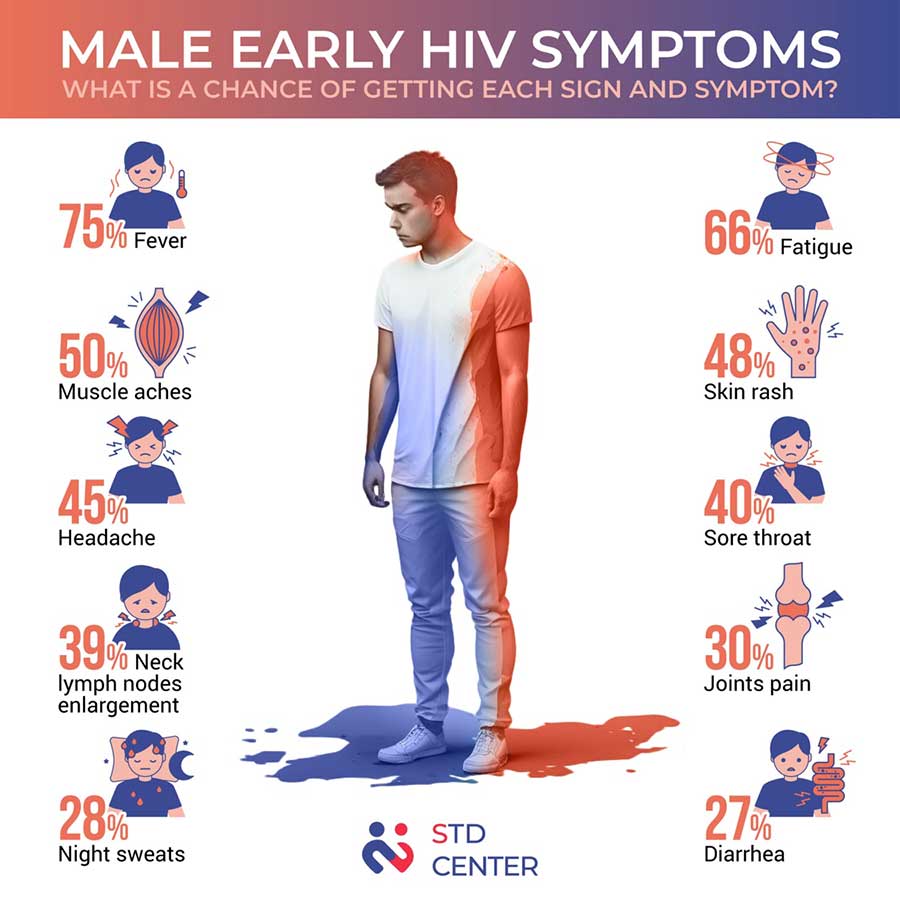
What are the early HIV symptoms in males?
HIV symptoms can be gender specific. Males get certain symptoms more often than females: muscle ache, joint pain, and night sweats.
Check the frequency of different HIV related signs and symptoms in males in this infographic:
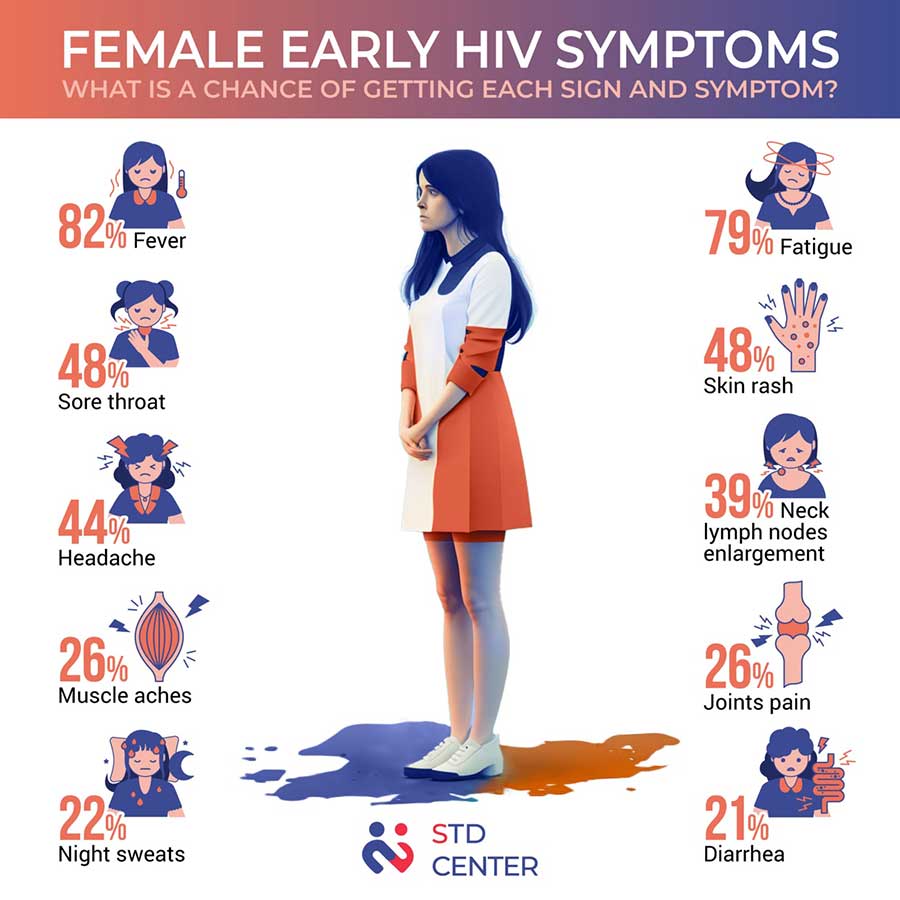
What are the early HIV symptoms in females?
Females, unlike males, get more frequent and profound fatigue. The rest of the symptoms are very similarin people of both genders.
Check the frequency of different HIV related signs and symptoms in females in this infographic:
How soon can HIV testing can be done?
| Test types | Earliest time the test can be done |
| HIV RNA | 10–15 days; 90% accurate |
| Ultrasensitive | 5 days afterexposure; 90% accurate |
| HIV p24 | 2 weeks after exposure; 95% accuracy |
An HIV RNA test(ultrasensitive) can be done much earlier than an HIV p24 test, but the HIV p24 test has better sensitivity(accuracy) later on.
The false positive rate for the HIV RNA test is 2.6%.
